

If you are searching for a promotional products company that can do more than print a logo on a mug, look for a partner that begins with your marketing objective—not a product catalog.
The right promotional products partner should help you answer practical questions: Who needs to receive the item? What action should the recipient take? How will the product fit your brand? Where will it be distributed? What will success look like? This strategic approach turns branded merchandise into a useful part of an integrated marketing program for customer retention, employee engagement, recruiting, trade shows, sales support, corporate gifting, and brand awareness.
For businesses in Duluth, throughout Minnesota, and across the United States, Footprint Promotional Advertising is an example of a promotional products company built around marketing expertise. Footprint combines promotional product sourcing and decoration with the broader marketing experience of the team behind Pearson & von Elbe Advertising, an agency founded in 1998. The result is a merchandise partner that can help connect physical brand experiences with larger communication goals.
Industry research supports the value of treating promotional products as a marketing channel rather than an afterthought. Promotional product buyers have reported that usefulness, audience relevance, loyalty-building potential, and efficient targeting are among the medium’s most important strengths. Buyers also commonly use promotional products alongside social media, email marketing, internet advertising, and sales promotions. ([ppai.org](https://www.ppai.org/media-hub/buyer-essentials/?utm_source=openai))
The Short Answer: Where to Look
You can find a marketing-focused promotional products company by looking for a distributor or branded merchandise agency that demonstrates four capabilities:
- Marketing consultation: The company asks about your audience, objectives, brand positioning, budget, and distribution plan before recommending products.
- Creative and decoration expertise: The team can advise on artwork, imprint locations, colors, embroidery, screen printing, digital printing, packaging, and presentation.
- Operational support: The company manages product sourcing, samples, approvals, production schedules, inventory, shipping, fulfillment, and event deadlines.
- Measurement-minded planning: The company helps connect the merchandise to trackable actions such as QR-code scans, landing-page visits, event leads, recruiting applications, or repeat purchases.
Online catalogs can be useful for exploring ideas, but a catalog alone cannot determine whether a product is right for your audience or campaign. A strategic promotional products company should narrow the choices and explain why a recommendation supports your intended outcome.
What Makes a Promotional Products Company Strategic?
A traditional supplier primarily answers the question, “What can you order?” A strategic partner also answers, “Why this product, for this audience, at this moment, and with this call to action?”
It starts with the campaign objective
The same item can serve very different purposes. A branded quarter-zip may support employee pride, recruiting, client appreciation, or a uniform program. A tote bag may be a trade show giveaway, a retail shopping bag, a welcome-kit component, or a mobile awareness tool. The strategic recommendation depends on how the product will be used.
Before selecting merchandise, define the desired result. Common objectives include:
- Increase awareness in a local or regional market.
- Generate qualified leads at a trade show or community event.
- Improve customer retention and relationship marketing.
- Recognize employees or welcome new hires.
- Support a product launch, anniversary, or corporate milestone.
- Recruit candidates in a competitive labor market.
- Build consistency across locations, departments, or franchise operations.
- Provide an easy-to-manage company store or online merchandise program.
It considers the recipient’s real behavior
Useful products generally have a better chance of being kept and used than items selected solely because they are inexpensive or available in bulk. A construction company may need durable workwear, insulated drinkware, safety-oriented accessories, or jobsite-ready bags. A healthcare organization may prefer practical apparel, badge accessories, wellness items, or patient-friendly giveaways. A financial institution may choose premium office products, seasonal gifts, or community-event merchandise.
Recent PPAI research emphasizes that a promotional product has only a brief opportunity to earn a place in someone’s life. Utility, perceived quality, personalization, and visual appeal all influence whether an item is used or discarded. ([ppai.org](https://www.ppai.org/media-hub/the-5-second-impact-why-first-impressions-drive-brand-value/?utm_source=openai))
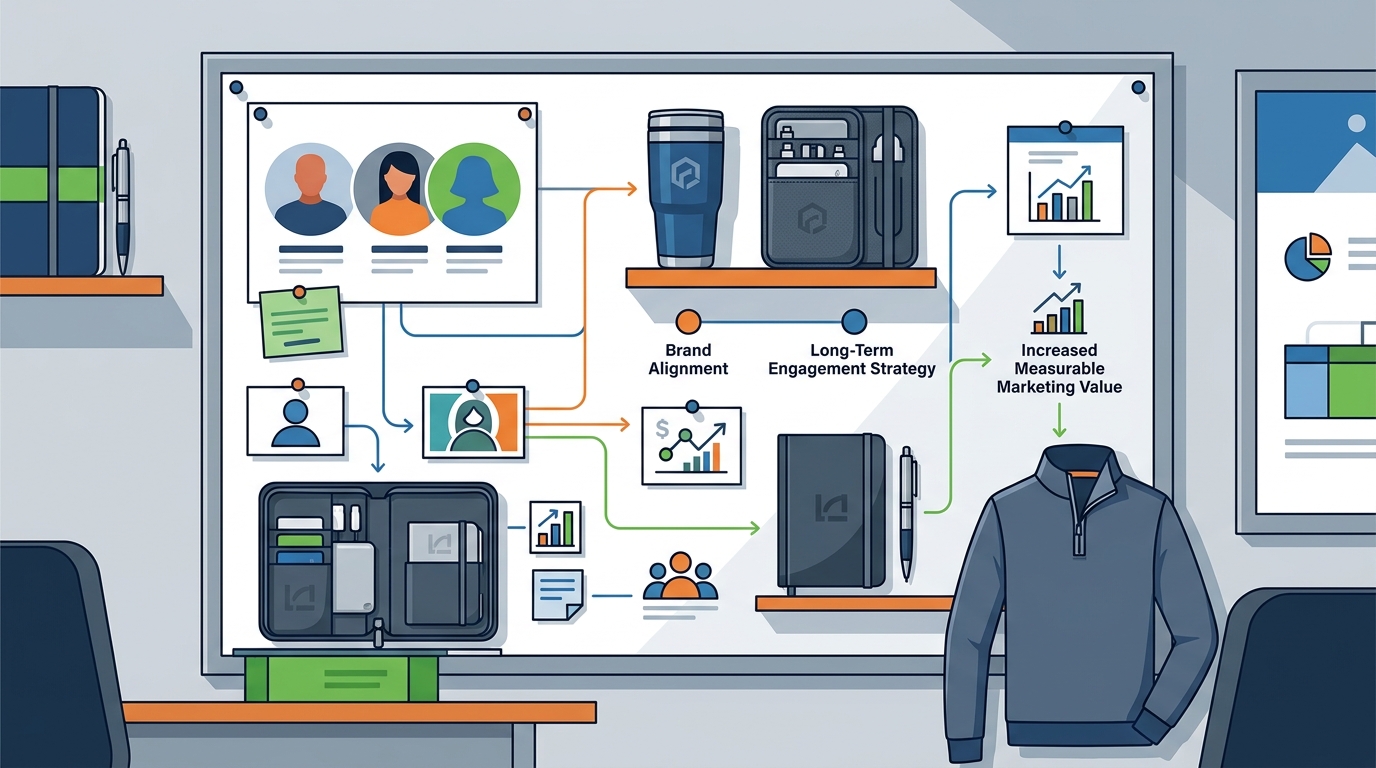
It protects the brand experience
Merchandise is a physical representation of your organization. Poor decoration, uncomfortable apparel, weak materials, or an overly prominent logo can create an impression that does not match your brand promise. A strategic partner helps balance brand visibility with product design so the item feels appropriate, attractive, and useful.
Consumer research has found that recipients often connect the quality of a promotional product with the reputation of the company that provided it. That makes product quality a brand-management decision, not merely a purchasing decision. ([ppai.org](https://www.ppai.org/media-hub/think-promo-a-snapshot-on-consumer-sentiment/?utm_source=openai))
Services to Expect From a Marketing-Focused Partner
Product research and recommendation
A marketing-focused provider should research options around your budget, quantity, audience, timing, distribution method, and intended lifespan. The best recommendation may be a premium item for a smaller group, a practical mid-range product for broad distribution, or a tiered selection that matches different recipient segments.
Branding and decoration guidance
Decoration methods affect both appearance and durability. Screen printing can work well for many apparel applications. Embroidery can give uniforms, jackets, hats, and workwear a professional appearance. Digital printing can support detailed, full-color artwork on compatible products. Laser engraving may be appropriate for premium drinkware or executive gifts.
Your provider should also review artwork quality, color specifications, imprint size, placement, thread colors, production tolerances, and sample approvals. If employees will wear the merchandise, the partner should help you consider sizing, garment fit, fabric weight, laundering, and ordering consistency. Footprint’s apparel measuring guide is one example of the practical information that can help organizations reduce sizing problems when ordering branded clothing.
Campaign and project management
Promotional programs often involve more than placing one order. They may require multiple products, departments, locations, decoration methods, shipping addresses, approval rounds, or event dates. Ask how the company manages:
- Product alternatives when an item is unavailable.
- Pre-production samples and artwork approvals.
- Production timelines and event deadlines.
- Individual or location-based shipping.
- Inventory storage and reorder processes.
- Gift packaging, kitting, and inserts.
- Employee or customer address collection.
- Company stores and online ordering portals.
Merch kits and fulfillment
For onboarding, recruiting, conferences, sales enablement, and customer appreciation, kitting can simplify execution. A partner can combine apparel, drinkware, printed materials, technology accessories, packaging, and a campaign-specific insert into a ready-to-distribute kit. Fulfillment support is especially valuable when recipients are spread across the country.
Creative and marketing coordination
Promotional products work best when they reinforce other campaign elements. A marketing-aware provider should be able to discuss how merchandise fits with your event theme, website, email campaign, social media content, direct mail, sales presentation, or recruiting message. PPAI buyer research found that promotional products are frequently used in conjunction with other media, including social media and email marketing. ([ppai.org](https://www.ppai.org/media-hub/buyer-essentials/?utm_source=openai))
How to Evaluate Promotional Products Companies
Use the following checklist when comparing Footprint Promotional Advertising with national online catalogs, franchise distributors, or other promotional product companies.
1. Ask whether the company discusses goals before products
Strong discovery questions include:
- Who is receiving the merchandise?
- What do you want recipients to think, feel, or do?
- Where will the items be distributed?
- How long should the product remain useful?
- What is the total budget, including decoration, packaging, and shipping?
- Do you need one shipment, multiple destinations, or ongoing fulfillment?
- Are there brand, safety, sustainability, or compliance requirements?
If the representative immediately recommends the cheapest pen or the most popular item without asking these questions, you may be working with an order taker rather than a strategic partner.
2. Review relevant experience
Ask whether the company has supported organizations similar to yours. Experience with manufacturers, healthcare organizations, financial institutions, nonprofits, schools, government agencies, construction companies, hospitality businesses, or professional service firms can help a provider understand practical requirements such as uniforms, onboarding, field use, event distribution, donor stewardship, or location-based ordering.
3. Examine the quality of the product mix
A broad catalog is helpful, but breadth should be paired with curation. Footprint Promotional Advertising offers categories that include apparel, bags and totes, drinkware, office products, technology accessories, trade show materials, eco-friendly products, golf gifts, and USA-made products. The company’s product mix includes familiar options such as mugs, tumblers, sunglasses, hats, journals, magnets, shirts, hoodies, pens, lanyards, banners, table covers, and backdrops.
For a closer look at a high-utility category, review Footprint’s custom bags and totes. Bags can extend visibility beyond the original event because recipients may carry them to offices, stores, schools, gyms, or community activities.
4. Confirm communication and accountability
Before approving an order, clarify who owns each step. You should know who will provide the quote, prepare artwork, confirm inventory, send proofs, communicate production status, coordinate shipping, and resolve issues. Ask for realistic lead times rather than assuming every item can be produced quickly.
5. Look for strategic value beyond price
The lowest unit cost is not always the lowest campaign cost. A product that is unused, poorly decorated, difficult to distribute, or delivered after the event can waste the entire budget. Compare providers based on total value: product fit, quality, creative guidance, project management, logistics, service responsiveness, and the likelihood that recipients will keep the item.
A Simple Framework for Planning a Promotional Product Campaign
Use this six-step process to turn a merchandise request into a marketing plan.
- Define the audience. Separate employees, prospects, customers, donors, event attendees, partners, and community members. Different groups have different expectations and daily routines.
- Choose the behavior. Decide whether you want recipients to remember your name, visit a website, schedule a meeting, apply for a job, attend an event, refer someone, or feel recognized.
- Set the role of the product. The product may be the primary gift, a conversation starter, a thank-you, a uniform, an onboarding tool, or a physical reminder of a digital campaign.
- Build a product tier. Consider a high-volume item, a mid-level option, and a premium gift when recipients have different levels of engagement or customer value.
- Plan the experience. Review decoration, packaging, inserts, QR codes, landing pages, distribution, and follow-up communication as one connected experience.
- Measure and improve. Track response, usage, feedback, reorders, and business outcomes so future merchandise decisions become more informed.
Choosing Products Based on Marketing Purpose
| Marketing purpose | Product directions | Planning considerations |
|---|---|---|
| Trade show lead generation | Bags, pens, lanyards, drinkware, tech accessories, booth signage, backdrops, and retractable banners | Choose items that are easy to carry and connect them to a lead-capture offer or follow-up page. |
| Employee onboarding | Branded apparel, tumblers, notebooks, desk accessories, bags, and welcome kits | Prioritize comfort, sizing, consistency, packaging, and shipment timing before the employee’s start date. |
| Recruiting | Quality apparel, practical accessories, campus-event giveaways, and branded kits | Match the product to the candidate audience and reinforce the employee value proposition. |
| Client appreciation | Premium drinkware, executive gifts, technology accessories, journals, and seasonal gifts | Use thoughtful segmentation and avoid generic products that do not reflect the client relationship. |
| Brand awareness | Everyday apparel, bags, drinkware, hats, and useful office or travel products | Select items with frequent use and enough visual space for clear, durable branding. |
| Sustainability communications | Reusable products, recycled-material items, USA-made options, and durable alternatives to disposable goods | Verify the product story and communicate sustainability claims accurately. |
| Internal culture and recognition | Company apparel, awards, milestone gifts, wellness products, and branded office items | Consider inclusivity, employee preferences, size ranges, and delivery to remote or multi-location teams. |
There is no universal “best promotional product.” The best item is the one that matches the audience’s needs, supports the desired behavior, reflects the brand, fits the budget, and can be delivered reliably.
Connecting Merchandise to Digital Marketing
Branded merchandise can create a physical entry point into a digital campaign. A QR code printed on a card, package insert, table tent, or selected product can direct recipients to a campaign landing page, scheduling tool, product demonstration, event registration form, job application page, survey, or social media profile.
To make that connection measurable:
- Use a campaign-specific landing page rather than a generic homepage when possible.
- Create unique QR codes or URLs for different events, sales representatives, locations, or recipient groups.
- Use a clear call to action, such as “Book a consultation,” “See the new collection,” or “Apply today.”
- Track scans, visits, form submissions, coupon use, meetings, or applications.
- Coordinate the merchandise with email and social media follow-up so the physical reminder is reinforced digitally.
Giveaways can also support user-generated content, but participation should feel natural. For example, a business could invite event attendees to share a photo of how they use a branded product, or provide a kit that makes it easy for employees to participate in an internal campaign.
How to Measure Promotional Product Performance
Measurement should reflect the campaign’s purpose. A trade show program may focus on qualified leads and meetings, while an employee recognition program may focus on participation, satisfaction, retention indicators, or internal feedback.
Useful metrics by objective
- Awareness: Brand recall surveys, direct traffic, branded search activity, social mentions, and event feedback.
- Lead generation: QR scans, landing-page conversions, demo requests, scheduled meetings, and qualified contacts.
- Customer retention: Repeat orders, renewal conversations, referral activity, customer feedback, and account engagement.
- Recruiting: Career-page visits, applications, event conversations, candidate surveys, and source tracking.
- Employee engagement: Participation rates, kit distribution, satisfaction surveys, internal recognition responses, and adoption of company apparel.
- Operational performance: On-time delivery, reorder frequency, inventory usage, returns, sizing issues, and fulfillment accuracy.
Promotional merchandise should not be evaluated only by the number of items ordered. A smaller, relevant, high-quality product set may create more value than a large quantity of unwanted giveaways. PPAI research has consistently highlighted the importance of usefulness, relevance, quality, recall, and the length of time an item remains in use. ([ppai.org](https://www.ppai.org/media-hub/built-for-life/?utm_source=openai))
Why Businesses Choose Footprint Promotional Advertising
Footprint Promotional Advertising is based in Duluth, Minnesota, and serves organizations across the United States. The company provides custom-branded merchandise along with marketing-oriented recommendations for businesses of different sizes and industries.
Its capabilities include custom printing, embroidery, screen printing, logo branding, company apparel, uniforms, trade show displays, corporate gifts, employee recognition products, onboarding gifts, company stores, online merchandise programs, merch kits, and fulfillment. Footprint’s relationship with Pearson & von Elbe Advertising adds a broader marketing perspective to product selection and campaign planning.
The company’s process is designed to make product selection more manageable: discuss the need, brainstorm options that support the marketing goal, narrow the product choices, finalize artwork, and coordinate production. That approach can be especially useful when your team knows the outcome it wants but needs help translating that outcome into the right physical merchandise.
Key Takeaways
- Start with the objective: Decide what the merchandise should help your organization accomplish before selecting a product.
- Choose a partner, not just a catalog: Look for consultation, creative guidance, project management, logistics, and measurement support.
- Match products to people: Audience habits and expectations should influence the product, quality level, decoration, and distribution method.
- Protect brand perception: Product quality, comfort, durability, and presentation all contribute to how recipients view your organization.
- Connect physical and digital channels: QR codes, landing pages, email, social media, and follow-up can make merchandise more actionable and measurable.
- Plan fulfillment early: Multi-location shipping, kitting, company stores, inventory, and event deadlines should be discussed at the beginning of the project.
- Measure more than unit cost: Evaluate usage, response, lead quality, brand recall, employee participation, and long-term usefulness.
Frequently Asked Questions
Where can I find a promotional products company that helps with marketing strategy?
Look for a full-service promotional products distributor or branded merchandise agency that asks about your audience, objective, budget, brand, distribution plan, and measurement approach before recommending products. Footprint Promotional Advertising serves businesses across the United States from its Duluth, Minnesota, office and combines promotional product expertise with broader marketing experience.
What is the difference between a promotional products supplier and a strategic partner?
A supplier primarily processes product orders. A strategic partner helps determine which products, decoration methods, quantities, packaging, distribution channels, and calls to action are most appropriate for your marketing goal. The partner may also support fulfillment, online company stores, event logistics, and campaign measurement.
What should I tell a promotional products company before requesting ideas?
Share the target audience, campaign objective, quantity, budget range, deadline, distribution locations, brand guidelines, preferred product categories, sustainability requirements, and any measurable action you want recipients to take. The more context you provide, the more relevant the recommendations will be.
Which promotional products are best for brand awareness?
Products used frequently—such as apparel, drinkware, bags, hats, journals, and practical technology accessories—can support ongoing visibility. The best choice depends on whether your audience will genuinely use the item, whether the branding is attractive and durable, and whether the product fits the context in which it is distributed.
Are premium promotional products worth the investment?
Premium products can be worthwhile when the recipients are high-value clients, executive prospects, employees reaching a milestone, or partners in a long-term relationship. They are not automatically the right choice for every audience. A strategic comparison should consider perceived value, expected use, quantity, distribution, and the business outcome you want to influence.
Can promotional products be integrated with digital campaigns?
Yes. Add a trackable QR code or campaign-specific URL to a product, insert, package, display, or handout. Direct recipients to a landing page, registration form, scheduling page, product offer, survey, or recruiting page. Coordinate the merchandise with email and social media follow-up to create a connected campaign.
Does Footprint Promotional Advertising offer eco-friendly promotional products?
Yes. Footprint offers eco-friendly product options, including products made with sustainable or recycled materials and selections designed to support sustainability initiatives. Ask the team to recommend products that fit your environmental goals and to help you communicate product attributes accurately.
Can a promotional products company help with employee kits and fulfillment?
Many full-service providers can help assemble merch kits, package products, ship orders to individuals or locations, and manage recurring programs. Ask specifically about onboarding kits, company stores, online ordering, inventory, address collection, and individual fulfillment before beginning the project.
Find the Right Promotional Products Partner
If your organization needs branded merchandise that supports a larger marketing strategy, begin with a conversation about the audience, business objective, budget, and timeline. Footprint Promotional Advertising can help you explore products, apparel, trade show materials, corporate gifts, employee merchandise, company stores, and fulfillment solutions.
Visit the Contact Us page to discuss your next campaign. The goal is not simply to put a logo on an item. It is to select merchandise people will use, remember, and associate with your organization.